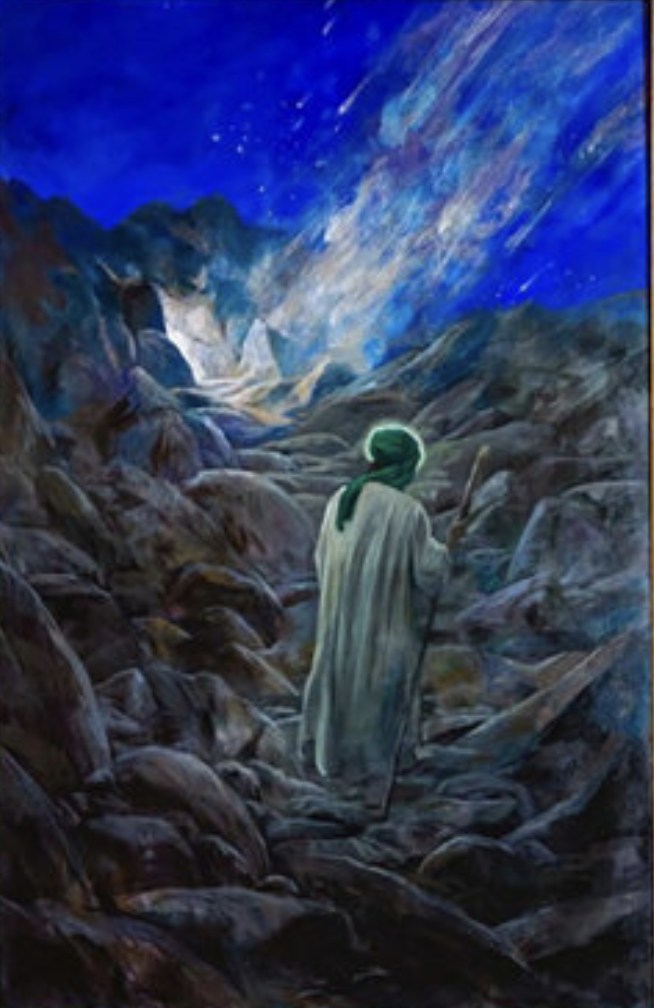
It is reported by al-Bukhārī and Muslim that Prophet Muhammad, blessings and peace upon him and his family, stated:
Your faith is not complete until I am more beloved to them than their children, their father, and all people (لاَ يُؤْمِنُ أَحَدُكُمْ حَتَّى أَكُونَ أَحَبَّ إِلَيْهِ مِنْ وَلَدِهِ وَوَالِدِهِ وَالنَّاسِ أَجْمَعِينَ)!
Ibn ʿArabī teaches that the reason loving another human being is the strongest force in the world is because human beings are the fullest expression of the Divine Names in a small package. And the Prophet Muhammad, blessings and peace upon him and his family, is the most perfect human embodiment of those Divine Names. This is why the hadith does not say that one should love him more than God. Our love for him is a reflection of our love for God.
At the most basic level, living the meaning of this hadith means that we persist in our obedience to the Prophet Muhammad, blessings and peace upon him and his family, even if it conflicts with the worldviews of those we love. I think of my Iranian-American friend who was raised in a completely secular fashion, and then in college he began to change. Even though his parents were from a Muslim-majority country and were raised as Muslims, their child now describes himself as “a convert” because he had to learn from scratch what it means to follow the Prophet Muhammad.
The Qur’an tells the Prophet Muhammad to tell humanity:
If you love God, then follow me, and God will love you (قُلْ إِن كُنتُمْ تُحِبُّونَ ٱللَّهَ فَٱتَّبِعُونِى يُحْبِبْكُمُ ٱللَّهُ).
When we wake up in the morning to pray ṣalāt al-fajr, we are following Muhammad.
When we do not drink alcohol, we are following Muhammad.
When we choose not to lie and face the consequences of being truthful, however bitter, we are following Muhammad.
And when we send blessings (ṣalawāt), whether in our ṣalāt or at any other time, we are building an ontological connection with Muhammad.
None of us really know Muhammad. We might memorize a description of him as related in a hadith, or perhaps recite poems about him written by people who lived centuries after his time. But that does not make our love for him any less real.
Imagine the living person you love the most in the world asks you to wake up every day at 5am, wash yourself, and face in a certain direction for a few minutes. If they did, you would probably ask yourself if they were deserving of your love. It might feel like a trick, meant to test our devotion to them, so that they could manipulate us in a sociopathic sort of way. We might feel that we had a choice between our own dignity and obeying this odd request.
But Muhammad asked us to do just that by praying ṣalāt al-fajr, and we never doubt that he did so for our benefit. Even if we do not actually do it out of laziness or doubt, we cannot bring ourselves to think that Muhammad lied to us or is trying to trick us. Why? Because the seed of the love of Muhammad is there, in our hearts. The seed of trust in Muhammad is part of who we are, so that even if we were raised without the ṣalawāt on our lips, we have become people who cannot imagine a world without the ṣalawāt.
It is stated by both Sunnī and Shīʿī mystics that saying, “Dearest God, bless Muhammad and the family of Muhammad (اللَّهُمَّ صَلِّ عَلَى مُحَمَّدٍ وَ آلِ مُحَمَّدٍ),” will always be accepted by God, even if said without attention and focus. It is an integral of our ritual prayer according to all schools (madhāhib), but can be said at anytime, even in a state of major ritual impurity.
So on this day my practical advice is simple.
Say ṣalawāt.
Say, “Dearest God, bless Muhammad and the family of Muhammad (اللَّهُمَّ صَلِّ عَلَى مُحَمَّدٍ وَ آلِ مُحَمَّدٍ)” as many times as feels right, even if just once.
And may we increase in capacity to love God and those who teach us how to love God, by the mercy of the Most Merciful.


 A Mercy Case
Leave a comment