bismillah al-Rahman al-Raheem
I have reached certain conclusions about politics.
One is that most people don’t actually understand it. Those who understand it have valid differences, but most people just have no clue. Politics is the ability to organize human beings to work together towards a tangible earthly goal. As such, militaries, schools, courts, legislatures, corporations, and other collective institutions are all “political” on some level.
My brother-in-law Muneeb, who studied political theory at Yale and Univ. of Chicago, always says that most of life can be boiled down to the dialectic between “autonomy versus solidarity.” I believe he is right. The basic unit of society is the individual – you can’t chop up a person into little bits. And from that foundation of individual autonomy all forms of solidarity are achieved. Walmart has approximately 2,300,000 employees, including Muneeb’s sister, my wife Sumaiya. They work together to bring thousands of products from around the globe to the shelves of almost 11,000 stores around the world. It is one of the most tangible forms of solidarity in the world.
If in economic terms Walmart gives us a form of solidarity, in terms of electoral politics it is political parties that express that solidarity. This graph shows us how the declining solidarity of the Democratic Party led directly to the Republican sweep of the 2016 elections:
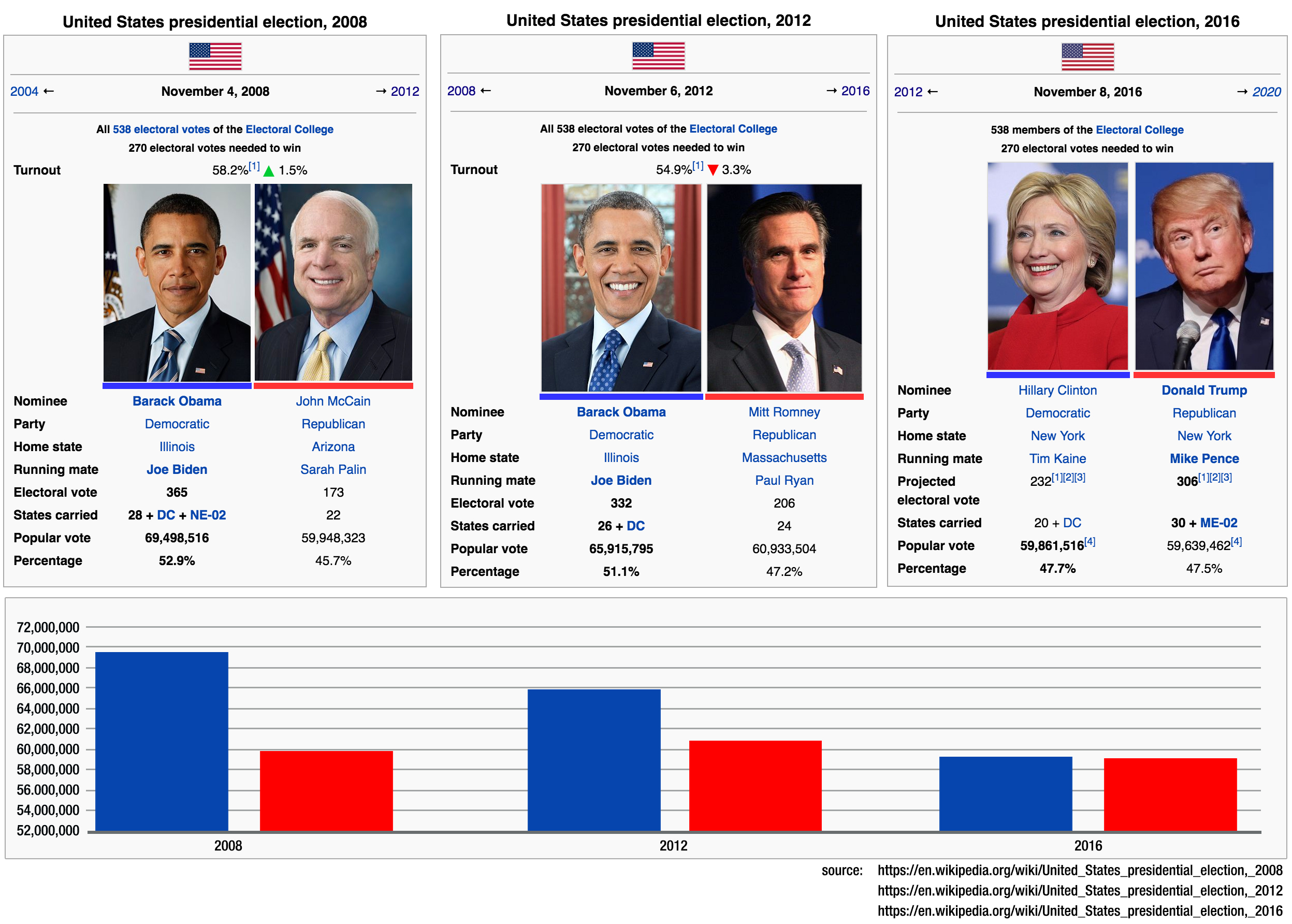
In 8 years, the Democratic Party lost the support of 10,000,000 voters. Trump won with less votes than both of the previous Republican candidates who lost! What caused that decline, I am not learned enough in American politics to know. But even though I am not a member of the Democratic Party, I voted Democrat in all three elections. Why? Because I know that my autonomy as an individual means very little when it comes to comes to electoral politics.
When I choose what to eat for breakfast, I have an enormous range of options. When I choose what to believe about the deeper metaphysical realities behind the events of human history, I can literally believe anything another human being has ever believed, or even make up something new. If I believe in something that others believe in, like the Qur’an, I have hundreds of non-profit organizations within NYC where I can worship alongside others who believe in the same thing. But when it comes to my NY Congressman, NY Senator, or President of the United States, I usually have two options, and there is only one winner.
When I choose to buy an organic, fair-trade coffee to drink for breakfast, it does not cause the maker of Folger’s (the J.M. Smucker Company) to go out of business. It does not cause Walmart to rethink their purchasing of Folger’s to stock on their shelves. Only if tens of millions of American consumers rethink their choice in coffee purchases will those corporations change. They have plenty of other consumers that in solidarity with them through their purchasing choices.
But there are currently only two political parties that really matter in the United States. Lack of solidarity towards one means greater strength for the other. Period. Full stop.
That is just how it is. That is the reality of this world we share.
And at the level of Muslims in America – the thing I know the most about – there is very little solidarity of significance. On the level of religion, the American system encourages division for the sake of ideological purity. If you want, you can create a religious organization to serve the needs of black gay Isma’ili women, get tax-exempt status, create a house of worship, publish books, and host annual conferences. But only 100 people will ever come, and that will be the limits of the solidarity you achieve. And that may be great for those 100 people, but it will do nothing for the approximately 324,000,000 American citizens who could care less.
Ayatollah Khomeini changed the structure of the Iranian government from a monarchy to a constitutional republic because the vast majority of the Iranian voters were in solidarity with him. The current generation of Iranians may debate the merits and dismerits of their system, but it was the solidarity of a previous generation that brought it into being. In the United States, we have not had a political revolution since 1865, when the Civil War brought about the end of the Secession. And all the states that seceded voted for Trump, with the exception of Virginia (the northernmost state). I do not think that is a coincidence, but representative of a deep and abiding political difference extending across generations.
So what is my point of explaining all of this? In short, it is to help everyone think more clearly about “autonomous ideals” and “the limits of solidarity.” When I am alone in my apartment reading books and praying, I can strive to determine my ideals to the furthest extant possible. When I leave to go to the supermarket, I can choose from 30 cereals that are made from grains grown around the world, and determine if any of them are “for” or “against” my ideals in some palpable way. Maybe I’ll find the perfect cereal. Maybe I won’t. But I have to choose something to eat, or else I will starve. Solidarity is only determined by the actual choices I can make as a consumer who does not grow his own food.
So when we come to realm of seeking explicitly political outcomes – the realm of domestic and foreign policy – we have to realize that the current system forces us to make choices. You can have ideological purity if you want. You can create a political party whose central goal is the return of all land taken from Native Americans in broken treaties. And your cause will be just, but you will actually achieve nothing of significance. Why? Because there are just not enough autonomous individuals at the national level that share your ideals.
For the believer, the complicating factor is accountability towards the Divine. If “opting out” feels right to you because of fear of Hellfire, then I am not going to critique you. But at least be cognizant of the fact that you are still part of the body politic, the capitalist world-system, and the American Muslim community at large. Your choices will continue to impact the rest of us. Because American citizenship is a form of involuntary solidarity that binds us together whether it reflects our ideals or not.
And God knows best.


 A Mercy Case
Leave a reply to a mercy case Cancel reply