In the middle of the night in a hotel in London, before I present a paper tomorrow on how to think about Islamic eschatology from a world historical perspective, I reread something I wrote towards the end of last month of Ramadan and it resonates so deeply still, as if I wrote it for myself months ago as a remind for my future self:
In the Name of God, The Merciful Benefactor, The Merciful Redeemer
al-salām ʿalaykum.
Today is the last Friday in the month of Ramadan. Last night was the 23rd night.
For me as an American convert to Islam who lives in California, this is the closest I get to earthly Islamic authority. God determined that the moon would decide the days and nights of Ramadan, and the Prophet Muhammad صلى الله عليه و آله و سلم demonstrated to the community that he led in Madinah in the 7th century how to fast during this time. Approximately 1400 years later, here I am, trying to obey God and God’s Messenger as best I know how, in a land that the Qur’an and the stories of Prophetic Madinah never mention.
It was also part of the prophetic teaching to single out the day of Friday as a day that represents prophetic authority. He would deliver a midday sermon to the people of Madinah in which he would address that which was most important to the community. Interestingly, there are very few sermons of his recorded in books of history, and none of them reach the level of historical certainty (mutawātir). He must have given hundreds of them, but we cannot say for sure that we know any of them.
But we can be certain that he taught the Muslims to look for the “Laylat al-Qadr” mentioned in the Qur’an in the last nights of the month of Ramadan. I am unaware of any dispute in Islamic intellectual history that the nights from the 19th onwards have a special spiritual significance and blessing.
And so here I am, an American who could eat a bacon cheeseburger and drink a beer right now if I wanted to, voluntarily choosing to fast on this day and honor its spiritual authority as one of the most blessed times of the year.
There is no caliph nor supreme leader nor sultan nor shaykh who is looking over my shoulder. There is only God, whose presence I feel vividly, and my accompanying angels that I cannot see. The devils are temporarily gone, although their servants amongst humanity remain with daily reminders of their power, wealth, corruption and injustice.
So where do I direct my earthly requirement for authority, if the day of Jumuʿah was initially about submitting to prophetic authority in 7th century Madinah?
The only answer that makes sense to me after 27 years as a Muslim is that I direct it toward al-Imām al-Mahdī, the eschatological figure mentioned in Sunnī and Shīʿī hadith literature. His fundamental goal is to “fill the earth with justice after it has been filled with injustice,” a teaching which tracks with what human beings look for in a leader across time, space, and culture.
I clearly live in a world of injustice that is not fair. The Qur’an gives me hope of an eternal accounting after history when every tyrant of the past will face justice. But what about today? To whom do I turn towards with absolute obedience, such that if they say fight I fight, and if they say make peace I make peace? To whom do I submit such that if they say give your money here, I do not question it, but simply reply “we hear and obey,” as the Qur’an says?
The answer is nobody that I have ever met face to face. And yet, the spiritual desire is still there, because when I read the Qur’an it tells me repeatedly to have absolute trust in prophetic authority. What I feel on Fridays and in the month of Ramadan and on Laylatul Qadr nights is the same feeling that made me voluntarily submit to the Book of God, and the same feeling that made me love the Messenger of God. For the Imam of God represents both the Book and the Messenger in their time. As many narrations describe him, he is “The Imam of this Age (Imām al-Zamān).”
And so I find it striking that the story goes like this:
At first, the Imams were patient with the increasing corruption of the caliphate, but by the time of al-Imām al-Ḥusayn, it got so bad that he had to make a great sacrifice that made the situation crystal clear for the rest of human history. After Karbala, the Imams suffered in various ways under successive governments, but did not revolt and did everything they could to guide the community. Until finally, al-Imām al-Hādī spent half of his life under house arrest in Samarra, and his son al-Imām al-ʿAskarī spent his whole life in house arrest, at which point for God’s Mercy to still flow to humanity the heir of complete prophetic authority had to be concealed from his oppressors until the judgement of God would come for all living beings for a final time just like it came with the flood of Noah in the distant past. And Jesus will come back just to make it 100% crystal clear that this was God’s plan all along.
And so here we are.
Duʿā al-Iftitāḥ, which Imāmī Shīʿī tradition maintains is narrated from al-Imām al-Mahdī and recommend to recite during the month of Ramadan, states at the end:
“O Allah, we complain to You about the departure of our Prophet, Your blessings be on him and on his Household, the absence of our leader, the big numbers of our enemies, the few number of us, widespread disorder, and the vicissitudes of time against us. So send blessings to Muhammad and his Household and help us overcome all that through victory from You that You expedite, through relieving us from our injuries, through Your help that You confirm, through bringing in the rule of justice and fair-play, through mercy that You expand over us, and through good health that You cover us with, by Your mercy, O most Merciful of all those who show mercy!”
Amen to that.
So why do I share this here?
Because this is my medium to access the global Muslim community. I have no other forum to honor the day of Friday in the month of Ramadan that includes Americans and Iranians and Indians and Pakistanis, Sunnis and Shi’is and Salafis and Sufis, all for the sake of God.
Because let us be honest – if not for God I would probably not know many of you. I would be off doing something else, hanging out with different people, completely oblivious to the fact that today is the last jumuʿah of Shahr Ramadan. But all praise is due to God Who guided us to this, and if it were not for God we would never have been guided.
And so if it was for God, let us see this through for the sake of God. The Qur’an relates that the Messenger of God did not always know how it was going to turn out, and so how do I know where my little part in this story is going either? I never thought I would become a Shīʿī as opposed to a Sunnī and I never planned to leave the East Coast for the West Coast. But I know what my faith is on this day, and that al-Imām al-Mahdī and the Last Day give me hope in both historical and eternal justice, two ideals which I have never seen but only read about in books and tried to imagine in my own head.
Blessings to all lovers of justice, whether they call themselves Muslims or something else, for to love justice and believe it is possible is to love the Just and Merciful God who reigns over planet Earth, the visible cosmos, and all that extends beyond.
And no human being would ever truly worship an unjust god.
lā ilāha…………illa Allāh
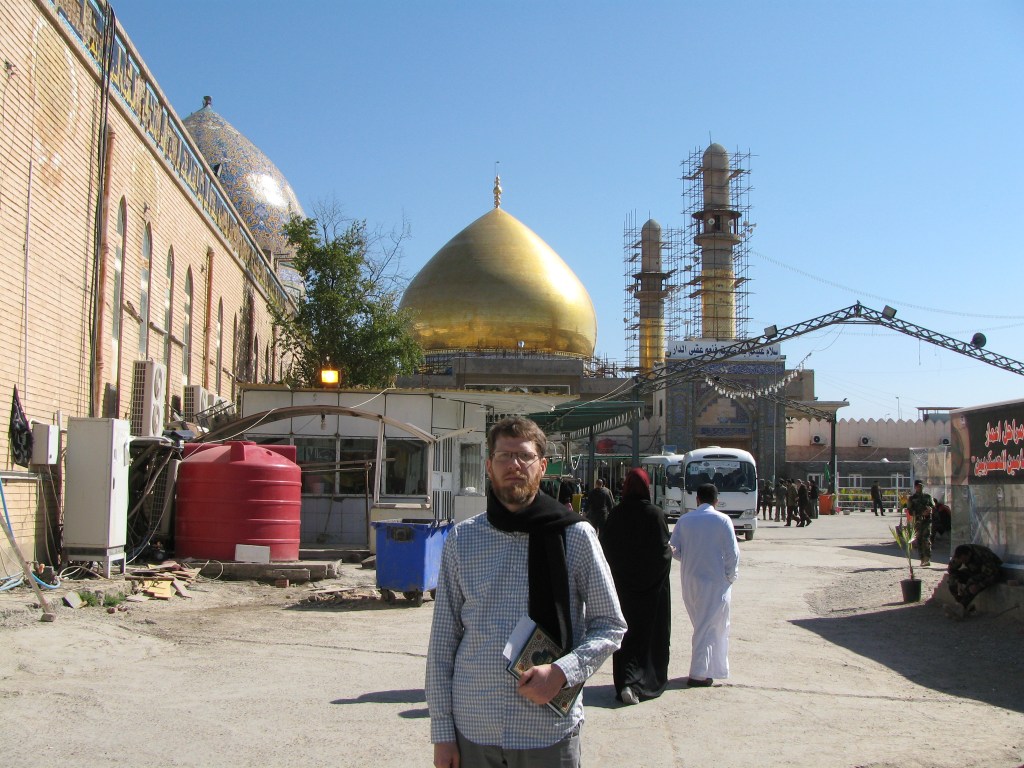
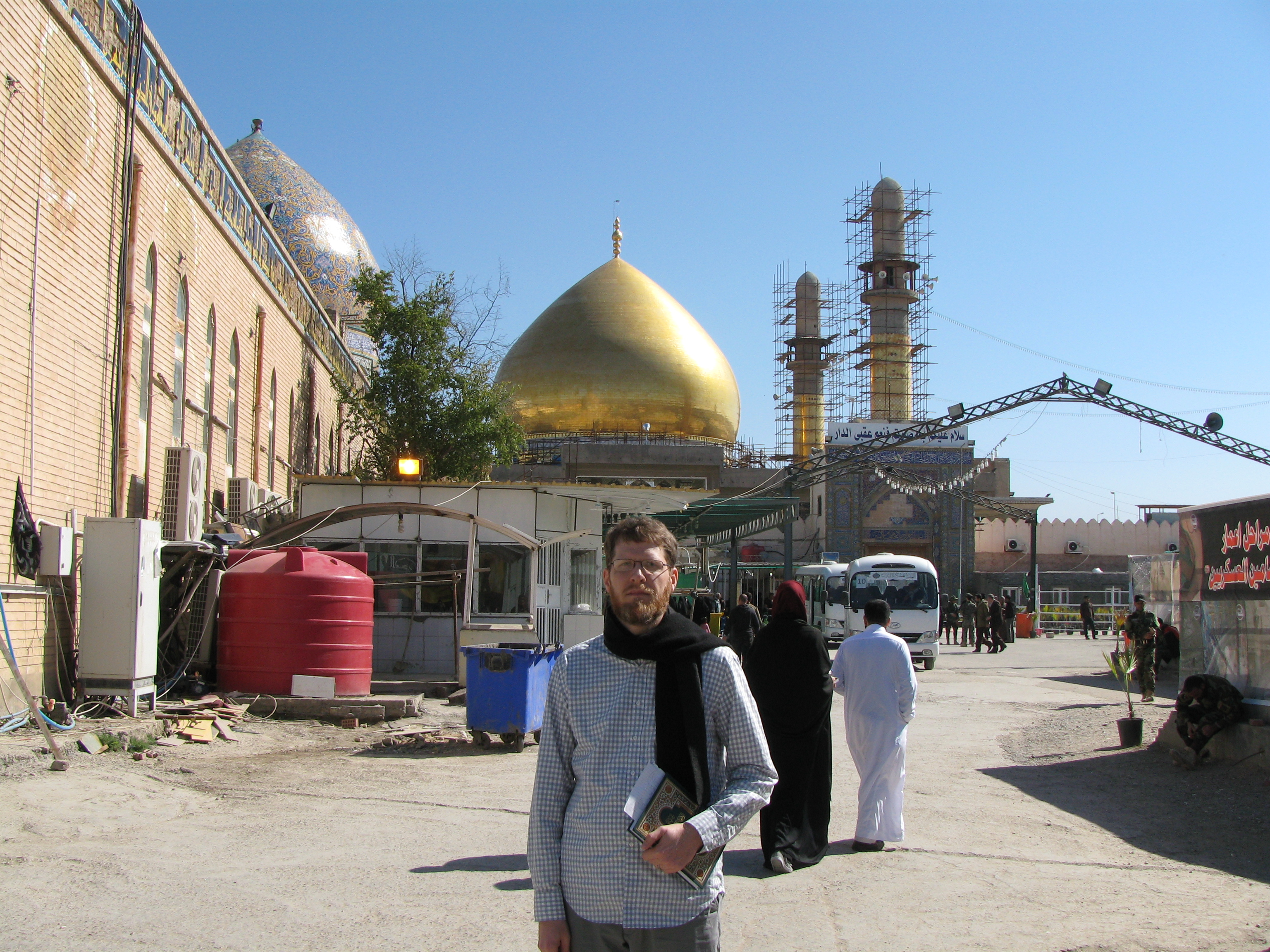
Me in Samarra, Iraq in 2016


Leave a comment